
Search
Online search is one of the most common ways people encounter content from Wikimedia platforms. Whether on classic result pages or AI-generated overviews, Wikipedia and its sister projects commonly appear among the fundamental sources of the information provided to search engine users.
Search platforms amplify Wikimedia's reach and serve as a primary gateway to free knowledge for billions of people worldwide. Consistent attribution in this scenario is necessary to safeguard the visibility of Wikimedia projects as providers of high-quality content, and to ensure that readers have clear access and contribution pathways back to the source.
The benefits of attribution in this context go beyond sustaining the growth of Wikimedia's ecosystem. Transparent sourcing and free access are critical for the existence of the broader open web and to ensure knowledge integrity online.

Wikipedia
https://en.wikipedia.org/wiki/AuroraMost read
98 contributors
6K+ views last month
An aurora is a natural light display in Earth’s upper atmosphere caused by charged particles from the Sun colliding with atoms in the atmosphere. These collisions excite oxygen and nitrogen, which then emit light of different colors such as green, red, and purple.

123 references
Donate to Wikipedia Attribution level: Ideal
Essential attribution
The essential signals outlined below are grounded in widely recognized Creative Commons attribution principles. In search contexts, essential attribution mainly involves clearly indicating the source of the content and enabling access to it for verification, further exploration, or the review of additional attribution details. Where content has been modified, attribution principles require signaling that changes were made in a way proportionate to the constraints of the interface.
Beyond key attribution elements, reusers are encouraged to follow licensing recommendations and surface additional signals in ways that are visible and accessible, but also appropriate to their product environment. There is no single prescribed format, as long as attribution remains reasonable and suited to the medium.
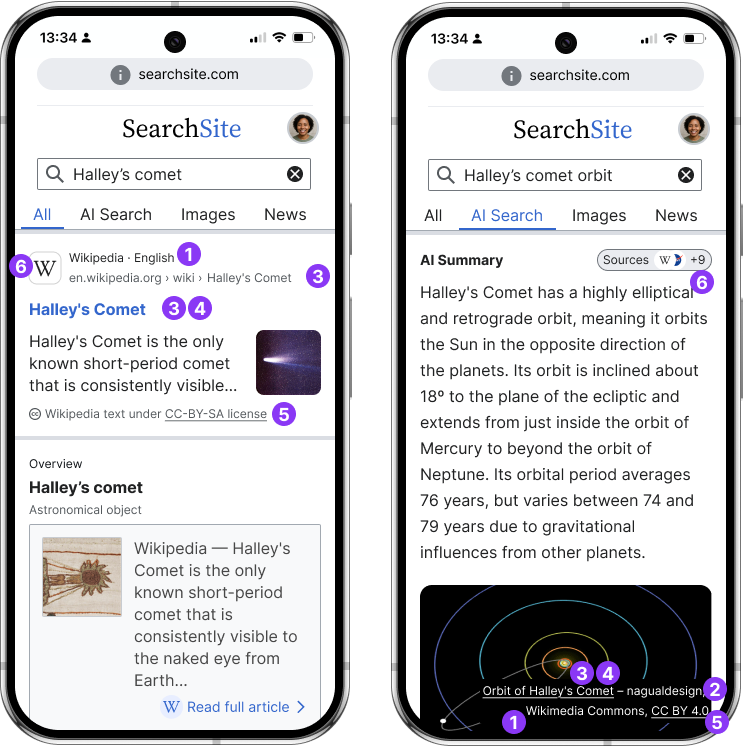
Note: You may adjust the appearance of the signals to follow your design guidelines and visual style in order to ensure consistency in your context.
1. Source
Required
Always identify the Wikimedia project from which the information originates. Use text or the project’s brand mark (see 6) if space is limited. See full signal spec →
Data sources:
- Wikimedia Attribution API
BetaRecommended - Wikimedia Enterprise API
Recommended - MediaWiki Action API
- URL parsing
High visibility on wiki: This signal is immediately visible at the source.
2. Credit
Required based on license type
When displaying media files (e.g., from Wikimedia Commons) in result pages, it's important to comply with the applicable license and either state or provide direct access to information about the individual author of the file. When reusing community-governed content under CC-BY-SA 4.0 licenses (e.g., Wikipedia articles), we recommend indicating that a list of authors is available at the source. See full signal spec →
Data sources:
- Wikimedia Attribution API
BetaRecommended - MediaWiki Action API (Allows retrieving credit information about Wikimedia Commons media files)
Mixed visibility on wiki: The visibility of this information varies per project. For example, it's immediately visible in Wikimedia Commons' file pages but requires reviewing articles' history on Wikipedia.
3. Link
Required
Provide direct access to the specific Wikimedia project page where the content in the results is being drawn from. See full signal spec →
Data sources:
- Wikimedia Attribution API
BetaRecommended - Wikimedia Enterprise API
Recommended - MediaWiki Action API
- URL manipulation
High visibility on wiki: This information is immediately visible at the source.
4. Title
Required Exceptions may apply
Identify the name of the page being retrieved. This is key for search engine users to assess relevance and identify contents at the source. We recommend omiting media files’ titles, which might not be very descriptive. This is recommended only as long as a link to the original materials is shared. See full signal spec →
Data sources:
- Wikimedia Attribution API
BetaRecommended - Wikimedia Enterprise API
Recommended - MediaWiki REST API
- MediaWiki Action API
- URL parsing
High visibility on wiki: This information is immediately visible at the source.
5. License
Required based on license type
We recommend finding an appropriate way to indicate the license of reused content. License notices are required when they imply any usage restrictions. See full signal spec →
Data sources:
- Wikimedia Attribution API
BetaRecommended - Wikimedia Enterprise API allows fetching licenses as part of article's structured contents, or retrieving an article's license object.
Recommended - MediaWiki REST API
- MediaWiki Action API allows retrieving license information about projects and individual media files
High visibility on wiki: This information is immediately visible at the source.
6. Brand mark
Required if the source isn't stated
Use brand marks to visually identify the source of the information being reused. They can replace the source when space is limited. See full signal spec →
Data sources:
Visual brand marks:
- Wikipedia Visual identity guidelines in Wikimedia Foundation's portal
- Other Wikimedia projects' brandmarks will be available in Wikimedia Commons
Coming soon - Wikimedia Attribution API
Beta - MediaWiki Action API
Audio brand marks:
High visibility on wiki: This information is immediately visible at the source.
7. Modification disclaimer
Required based on license
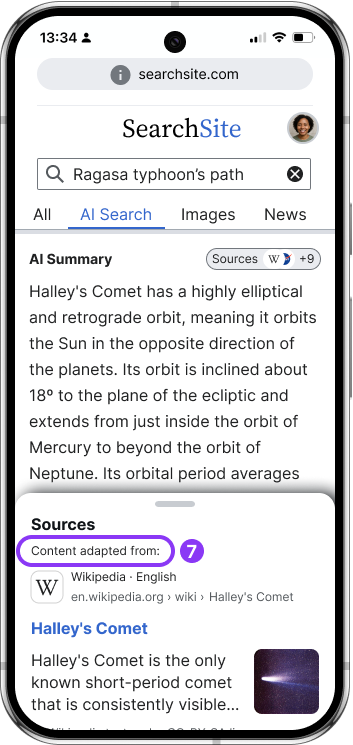
Modifications or additions made to Wikimedia content or media files need to be stated, as required by the individual applicable licenses. This is implied by CC BY-SA 4.0, which governs most Wikimedia project's text content. Terms might vary for media files, to which more diverse licensing applies. We also require displaying disclaimers associated with aggregated content, such as that produced by AI search assistants. Moreover, under no circumstances should aggregated content be attributed to a single source. See full signal spec →
Trust and relevance signals
Recommended
Beyond essential attribution, search results can help users assess the relevance and reliability of the information being surfaced. Signals such as reference count, editor activity, or readership data make visible the collaborative and verifiable processes that underpin Wikimedia projects, as well as their broad public reach.
Highlighting trust signals strengthens the credibility of both the content and the platform reusing it, while guiding audiences toward sources grounded in active stewardship, rigorous referencing and open discussion.
Reference count
Use this Wikipedia-specific credibility signal to expose the number of sources backing an article’s content. See full signal spec →
Data sources:
- Wikimedia Attribution API
Beta - Wikimedia Enterprise API
- Crawling and self-parsing
Medium visibility on wiki: This information is verifiable when articles contain numbered reference lists.
Contributor count
This Wikipedia-specific trust signal indicates the number of volunteers who have contributed to creating or gathering the information available in the original Wikimedia project page. See full signal spec →
Data sources:
Medium visibility on wiki: This information is visible but requires accessing a data dashboard from articles' Revision history.
Page views
Use this signal to express the total number of views that a specific Wikimedia page has received during the previous month. See full signal spec →
Data sources:
- Wikimedia Attribution API
BetaRecommended - Wikimedia Analytics API
- Wikimedia dumps
Medium visibility on wiki: This information is visible but requires accessing a data dashboard from articles' Revision history.
Attribution count
Use this signal to indicate (numerically or not) the popularity of a specific resource in your system, based (for example) on the number of impressions. See full signal spec →
Trending indicator
Use this attribute to flag Wikipedia articles that are ranking among the most read or edited pages in their respective language. Trending often correlates with unfolding events. For that reason, this signal is useful to communicate timely relevance. See full signal spec →
Data sources:
- Wikimedia Attribution API
BetaRecommended - Wikimedia Analytics API
No visibility on wiki: This information is currently not available on Wikimedia pages.
Last update
Use this recency signal to display the timestamp of the latest update applied to the Wikimedia page being retrieved or reused (e.g., “Last update 22 September 2025”). See full signal spec →
Data sources:
- Wikimedia Attribution API
BetaRecommended - Wikimedia Enterprise API
Recommended - MediaWiki REST API
- MediaWiki Action API
Medium visibility on wiki: This information is available in pages' history (requires navigation).
Ecosystem growth signals
Recommended
Attribution is not only about credit and transparency. It can also play an essential role in sustaining the future of free knowledge. By including a clear participation call-to-action (CTA) in search results, and inviting audiences to contribute back, reusers can help complete the knowledge loop. Supporting the continued growth and renewal of Wikimedia projects ensures that the information surfaced today keeps being enriched and expanded by volunteers tomorrow.
Participation CTA
Use participation CTAs to provide context-appropriate prompts that invite your audience to contribute to the Wikimedia ecosystem. See full signal spec →
Data sources: