
V1 Beta. This is a first release for early review by internal and external audiences.

Skip to content

Media and publications

Independent blogs and legacy news outlets often reuse text, images, and structured data from Wikimedia projects in order to contextualize, fact-check, and illustrate stories. Attribution practices in media and publications vary broadly, with direct links (and sparingly, minimal indications of source) being most frequent due to the time-based constraints faced by authors in these mediums.

We encourage the recognition of Wikimedia as a source by media outlets in a reasonable way and within the limitations of this fast-paced reuse context. Attribution is not only essential to honor licensing or provide fair credit; in the current times, signals making human-driven knowledge transparent can stand as a differentiating factor for online publications and have a huge impact on the perceived reliability of media outlets’ content.

The Dance of Light: Understanding Earth's Aurora Phenomenon

2 hours ago·Sarah Mitchell

An aurora is a natural light display in Earth's upper atmosphere created when charged particles from the Sun collide with atmospheric atoms, producing colorful curtains and rays of light. These phenomena occur in high-latitude regions around both magnetic poles, driven by disturbances in Earth's magnetosphere caused by solar wind activity.

Aurora borealis over Eielson Air Force Base, Alaska
United States Air Force.Adapted fromWikimedia Commons.CC-BY-SA 3.0

Aurora displays range from subtle green glows near the horizon to dramatic multicolored curtains stretching across the entire sky. The colors—green from oxygen at 60–150 miles altitude, red from higher oxygen atoms, blue and purple from nitrogen—paint the darkness in patterns that have inspired mythology across Indigenous and Nordic cultures for millennia.

“In 1859, the Carrington Event produced auroras so vivid that people in Boston could read newspapers outdoors at one o'clock in the morning.”

Wikipedia

Aurora, via Wikipedia

With 123 references

98 contributors

Attribution level: Ideal

Essential attribution

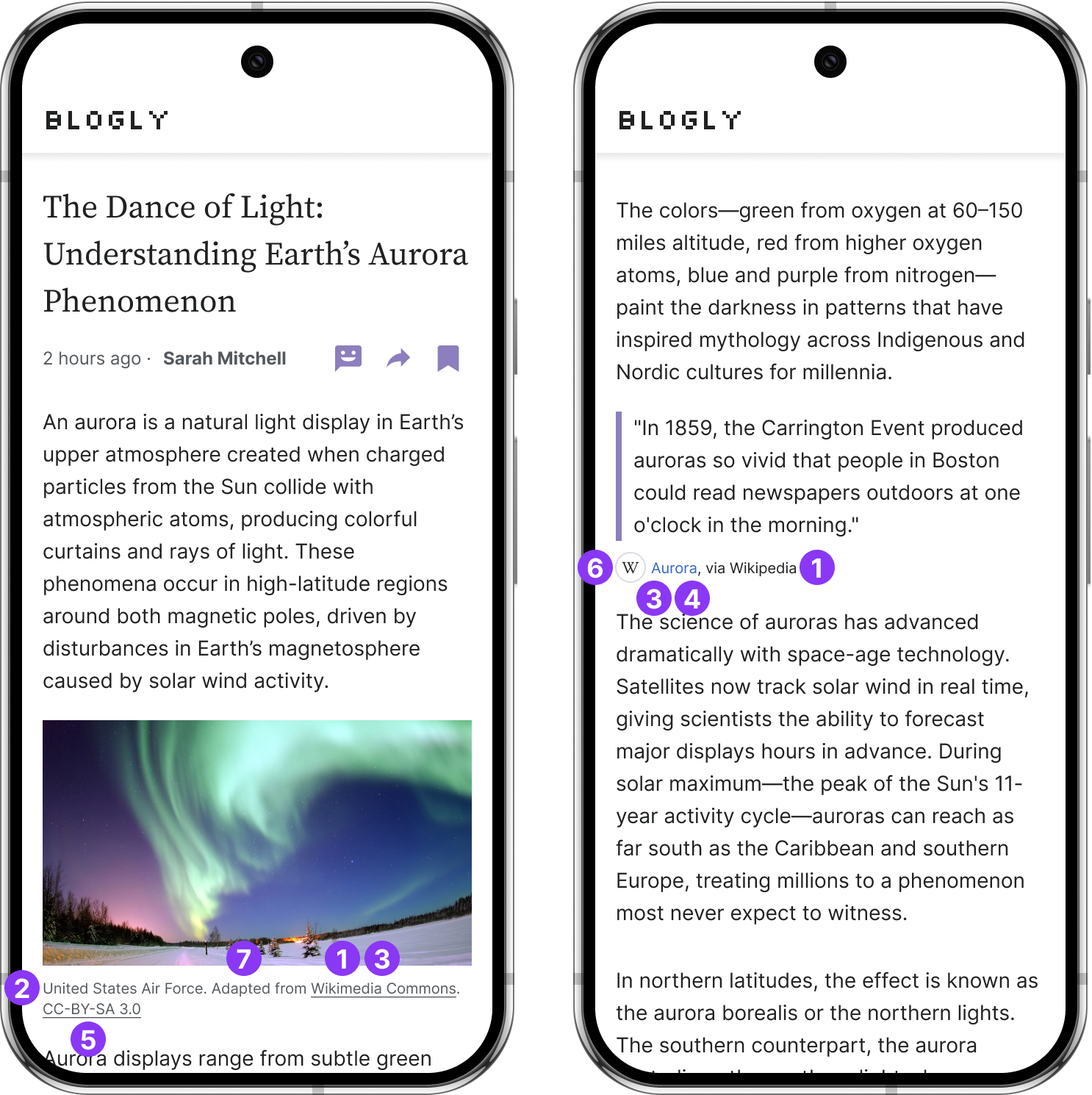
Media publications should provide essential attribution when reusing Wikimedia content, whether by quoting text, embedding images, or grounding facts or visualization on structured data. The essential signals described below are grounded on widely recognized Creative Commons attribution principles. Clearly indicating sources, including original titles, and linking back to the Wikimedia project, alongside required license or modification notices, is recommended to ensure compliance with fair credit.

Media and publications signal example image

  1. Source • 2. Credit • 3. Link • 4. Title • 5. License • 6. Brand mark

Note: You may adjust the appearance of the signals to follow your design guidelines and visual style in order to ensure consistency in your context.


1. Source

Required

We strongly recommend identifying the Wikimedia project from which information is sourced, if space for sources is available in context. Use text or, exceptionally, the project’s brand mark (see 6) if space is constrained. See full signal spec →

Data sources:

High visibility on wiki: This signal is immediately visible at the source.

2. Credit

Required based on license type

Give credit whenever possible. Especially when sharing media files (e.g., from Wikimedia Commons), state or provide direct access to information about the author as required by the file’s individual license. See full signal spec →

Data sources:

Mixed visibility on wiki: The visibility of this information varies per project. For example, it's immediately visible in Wikimedia Commons' file pages but requires reviewing articles' history on Wikipedia.

Required

Provide direct access to the specific Wikimedia project page (articles, media files, etc.) used as a source or featured in any publication. See full signal spec →

Data sources:

High visibility on wiki: This information is immediately visible at the source.

4. Title

Required Exceptions may apply

Identify the name of the source page from which information was retrieved. Titles are key for recognition and for readers to assess the relevance of article sources. These signals can be truncated if space limitations apply.

Given that media files’ titles can be unwieldy and might not contribute a lot of meaning, we recommend omitting this information when attributing images. This suggestion applies only as long as access to the original file is provided in context. See full signal spec →

Data sources:

High visibility on wiki: This information is immediately visible at the source.

5. License

Required based on license type

We recommend finding an appropriate way of indicating the license of reused content. The recommendation becomes a requirement in case the license implies any usage restrictions. See full signal spec →

Data sources:

High visibility on wiki: This information is immediately visible at the source.

6. Brand mark

Required if the source isn't stated

Use brand marks to visually represent the source of the information being reused or cited. They may replace textual indicators of source in case space is limited. See full signal spec →

Data sources:

Visual brand marks:

Audio brand marks:

High visibility on wiki: This information is immediately visible at the source.

7. Modification disclaimer

Required based on license

Modifications or additions made to Wikimedia content or media files need to be announced in an appropriate way for the medium. This is implied by CC BY-SA 4.0, which governs most Wikimedia project's text content. Terms might vary for media files, to which more diverse licensing applies.

Under no circumstances should content mixed from different sources be attributed to a single project or page. See full signal spec →


Trust and relevance signals

Recommended

Readers turn to media outlets expecting accuracy and authority. By surfacing trust signals such as reference counts, last update, or page views, publications can provide transparency into the recency and relevance of Wikimedia’s human-curated knowledge. Trust and relevance cues have been devised to highlight the reliability of the information being republished and to strengthen the confidence of readers in both the source and the media brand that draws upon it.

Reference count

Use this Wikipedia-specific credibility signal to expose the number of citations backing an article’s content.. See full signal spec →

Data sources:

Medium visibility on wiki: This information is verifiable when articles contain numbered reference lists.

Contributor count

This trust signal indicates the number of volunteers that have contributed to creating or gathering the information available in the original Wikimedia project page.. See full signal spec →

Data sources:

Medium visibility on wiki: This information is visible but requires accessing a data dashboard from articles' Revision history.

Page views

Use this signal to express the total number of views that a specific Wikimedia page has received in a predefined period of time, and communicate the relevance of your sources. See full signal spec →

Data sources:

Medium visibility on wiki: This information is visible but requires accessing a data dashboard from articles' Revision history.

Attribution count

Use this signal to indicate (numerically or not) the popularity of a specific resource in your platform, based (for example) on the frequency of use. See full signal spec →

This signal flags Wikipedia articles that are among the most read and/or edited. The trending indicator highlights timely relevance, as increases in page views and/or edits often correlate with readers’ interest in unfolding events. See full signal spec →

Data sources:

No visibility on wiki: This information is currently not available on Wikimedia pages.

Last update

In fast-moving news cycles, timeliness is critical. Use this signal to highlight the freshness of sources by making transparent the latest update of a Wikimedia page. It can be formatted as a timestamp (e.g., “Last update 22 September 2025”) or a relative format (“Updated 3 minutes ago”). See full signal spec →

Data sources:

Medium visibility on wiki: This information is available in pages' history (requires navigation).