
AI assistants
AI-powered chatbots and agents increasingly serve as intermediaries between users and human-governed knowledge. Unlike traditional search results, AI assistants often blend information from multiple sources into single answers, making attribution challenging but also vital.
Wikimedia projects' content is already widely used as a source in LLM systems. Including attribution in chat outputs ensures proper credit for our community of contributors, helps preserve transparency, and highlights Wikimedia projects as trusted sources of human-curated information in the age of AI.
What causes an aurora and why does it appear in different colors?
Auroras are caused by charged particles from the Sun — carried by the solar wind — colliding with atoms in Earth's upper atmosphere. These collisions excite oxygen and nitrogen atoms, which release energy as light. Wikipedia
Auroras occur on other planets with magnetic fields too, including Jupiter, Saturn, Uranus, and Neptune. Wikidata
Content adapted from:

Aurora
Wikipedia
aurora (Q40609)
Wikidata
Attribution level: Ideal
Essential attribution
The key attribution signals outlined in this section are based on Creative Commons licensing recommendations. In conversational interfaces, essential attribution must above all ensure that users can identify and access the sources of the information that was blended to generate AI dialogue. Modification disclaimers are particularly essential in this context, as they indicate to end users that responses are based on aggregated content.
In addition to essential attribution signals, reusers are encouraged to follow applicable licensing recommendations and provide additional signals in ways that suit the medium and context of reuse. Attribution does not follow a single prescribed format; rather, it should be reasonable, proportionate, and appropriate to the environment in which the content appears.
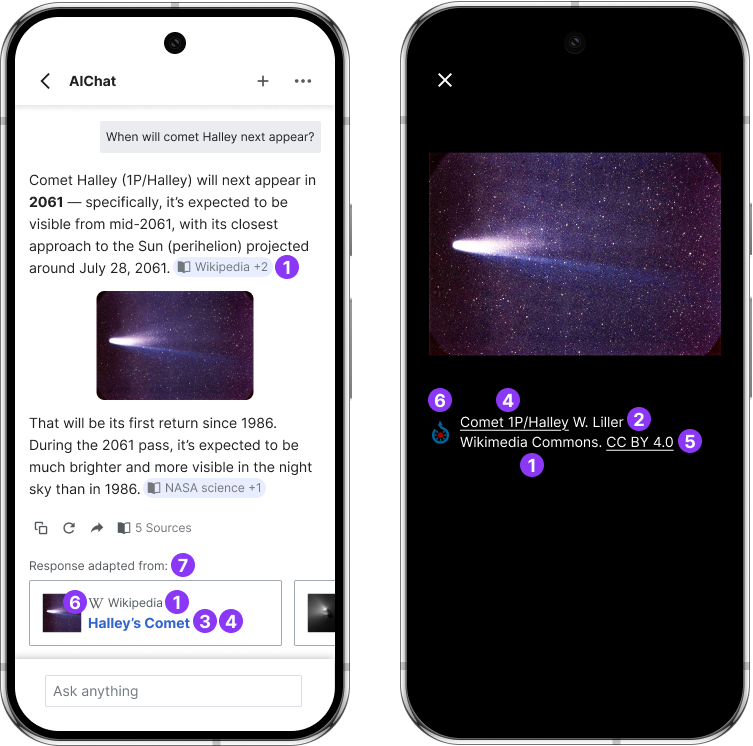
- Source • 2. Credit • 3. Link • 4. Title • 5. License • 6. Brand mark · 7. Modification disclaimer
Note: You may adjust the appearance of the signals to follow your design guidelines and visual style in order to ensure consistency in your context.
1. Source
Required
Identify the Wikimedia project from which the information originates. Use text or the project’s brand mark (see 6) if space is limited. See full signal spec →
Data sources:
- Wikimedia Attribution API
BetaRecommended - Wikimedia Enterprise API
Recommended - MediaWiki Action API
- URL parsing
High visibility on wiki: This signal is immediately visible at the source.
2. Credit
Required based on license
When media files (e.g., from Wikimedia Commons) are embedded in AI responses, authorship information should be stated or made directly accessible in accordance with the applicable license. When reusing community-governed content under CC-BY-SA 4.0 licenses (e.g., Wikipedia articles), we recommend indicating that a list of authors is available at the source. See full signal spec →
Data sources:
- Wikimedia Attribution API
BetaRecommended - MediaWiki Action API (Allows retrieving credit information about Wikimedia Commons media files)
Mixed visibility on wiki: The visibility of this information varies per project. For example, it's immediately visible in Wikimedia Commons' file pages but requires reviewing articles' history on Wikipedia.
3. Link
Required
Provide direct access to the specific Wikimedia project pages used to generate the assistant’s response or containing related information. See full signal spec →
Data sources:
- Wikimedia Attribution API
BetaRecommended - Wikimedia Enterprise API
Recommended - MediaWiki Action API
- URL manipulation
High visibility on wiki: This information is immediately visible at the source.
4. Title
Required Exceptions may apply
Identify the names of the Wikimedia pages being used as sources. This is key for users to identify relevant subsequential reading. Given that media files’ titles can be unwieldy and might not contribute a lot of meaning, we recommend omitting this information when attributing images. This suggestion applies only as long as access to the original file is provided in context. See full signal spec →
Data sources:
- Wikimedia Attribution API
BetaRecommended - Wikimedia Enterprise API
Recommended - MediaWiki REST API
- MediaWiki Action API
- URL parsing
High visibility on wiki: This information is immediately visible at the source.
5. License
Required based on license
You must find an appropriate way to indicate the license that governs the reused content. This is particularly required if the license implies any usage restrictions. Providing access to full license deeds is considered a good practice. See full signal spec →
Data sources:
- Wikimedia Attribution API
BetaRecommended - Wikimedia Enterprise API allows fetching licenses as part of article's structured contents, or retrieving an article's license object.
Recommended - MediaWiki REST API
- MediaWiki Action API allows retrieving license information about projects and individual media files
High visibility on wiki: This information is immediately visible at the source.
6. Brand mark
Required if the source isn't stated
Use brand marks to visually identify the source of the information being reused. A brand mark can replace the source when space is limited. See full signal spec →
Data sources:
Visual brand marks:
- Wikipedia Visual identity guidelines in Wikimedia Foundation's portal
- Other Wikimedia projects' brandmarks will be available in Wikimedia Commons
Coming soon - Wikimedia Attribution API
Beta - MediaWiki Action API
Audio brand marks:
High visibility on wiki: This information is immediately visible at the source.
7. Modification disclaimer
Required based on license
AI-generated outputs should be accompanied by clear disclaimers stating that they have been produced through the aggregation of multiple sources. This is implied by CC BY-SA 4.0, which governs most Wikimedia project's text content. Terms might vary for media files, to which more diverse licensing applies. Under no circumstances should aggregated content be attributed to a single source. See full signal spec →
Trust and relevance signals
Recommended
Trust signals such as reference counts, contributor activity, and readership data can help support the credibility of AI-generated responses, complementing and enhancing essential attribution. These signals demonstrate that knowledge hosted on Wikimedia platforms is the product of active review and collaboration, reinforcing both the reliability of source information and the conversational system presenting it.
Reference count
Use this Wikipedia-specific credibility signal to expose the number of sources backing an article’s content. See full signal spec →
Data sources:
- Wikimedia Attribution API
Beta - Wikimedia Enterprise API
- Crawling and self-parsing
Medium visibility on wiki: This information is verifiable when articles contain numbered reference lists.
Contributor count
This trust signal indicates the number of volunteers that have contributed to the information available in the original Wikimedia project page. See full signal spec →
Data sources:
Medium visibility on wiki: This information is visible but requires accessing a data dashboard from articles' Revision history.
Page views
Use this signal to express the total number of views that a specific Wikimedia page has received during the previous month. See full signal spec →
Data sources:
- Wikimedia Attribution API
BetaRecommended - Wikimedia Analytics API
- Wikimedia dumps
Medium visibility on wiki: This information is visible but requires accessing a data dashboard from articles' Revision history.
Attribution count
Use this signal to indicate that a Wikipedia (or other Wikimedia) source is both frequently reused and actively referenced within the LLM’s ecosystem. See full signal spec →
Trending indicator
Use this attribute to flag Wikipedia articles that are ranking among the most read or edited pages in their respective language. Trending often correlates with unfolding events. See full signal spec →
Data sources:
No visibility on wiki: This information is currently not available on Wikimedia pages.
Last update
Use this attribute to indicate the most recent update of a Wikimedia page as a timestamp (e.g., “Last update 22 September 2025”) or a relative format (“Updated 3 minutes ago”). See full signal spec →
Data sources:
- Wikimedia Attribution API
BetaRecommended - Wikimedia Enterprise API
Recommended - MediaWiki REST API
- MediaWiki Action API
Medium visibility on wiki: This information is available in pages' history (requires navigation).
Ecosystem growth signals
Recommended
LLM systems have the power to support the sustainability of the knowledge they reuse and depend on. A participation call-to-action (CTA) embedded in responses or source panels has the potential to facilitate the transition of users from consumers to contributors. By creating visible paths back to editing and engagement, AI assistants can play a key role in keeping the cycle of free knowledge active.
Participation CTA
Use participation CTAs to provide context-appropriate prompts to invite your audience to contribute to the Wikimedia ecosystem. See full signal spec →
Data sources: