
Games and rich media experiences
Games and rich media applications frequently draw on Wikimedia content to power narrative experiences or interactive learning. These contexts rely on creating immersive environments to draw user engagement, which may cause sources to naturally become secondary.
We identified games and rich media experiences as key scenarios because they highlight the need for attribution patterns that can integrate seamlessly within interactive environments. The goal in the context of this reuse scenario is to ensure that Wikimedia’s contributions remain clear, trusted, and recognized, while still respecting the focused player and user experience.
Attribution in immersive experiences
For games and rich media experiences, attribution is intended to enhance the user experience without causing distractions from the immersive interactive experience. Identifying the moments where attribution can be more prominent and where it may be presented in a more subtle way is key in this context.
Although each game or interactive experience is unique, there are some common phases that could serve as reference points for attribution:
- Pre-game: Before the game starts, signals can be used to convey trustworthiness of Wikimedia content being used by the experience.
- In-game: While playing, limit time and attention for additional signals that are not part of the core game experience. Depending on the pace and the learning focus of the game, there may be more or fewer opportunities to effectively show attribution signals.
- Post-game: After finishing the game, more detailed credits at the end can complement the user experience, enabling players to understand how the contents were created and enable them to learn more.
The “pre-game” and, especially, the “post-game” steps tend to provide more room for detailed attribution signals, while a player’s focus and attention during the in-game experience may be much more limited. This is illustrated in the configurable example.
Select a screen to configure
Game name
Pre-game
Level 2
Question 8/10

In-game
Your score
Content credits
Question 1
Correct! Find more information:
Aurora
Wikipedia
An aurora is a natural light display in Earth’s upper atmosphere caused by charged particles from the Sun colliding with atoms in the atmosphere. These collisions excite oxygen and nitrogen, which then emit light of different colors such as green, red, and purple.
123 references
Question 2
Correct! Find more information:
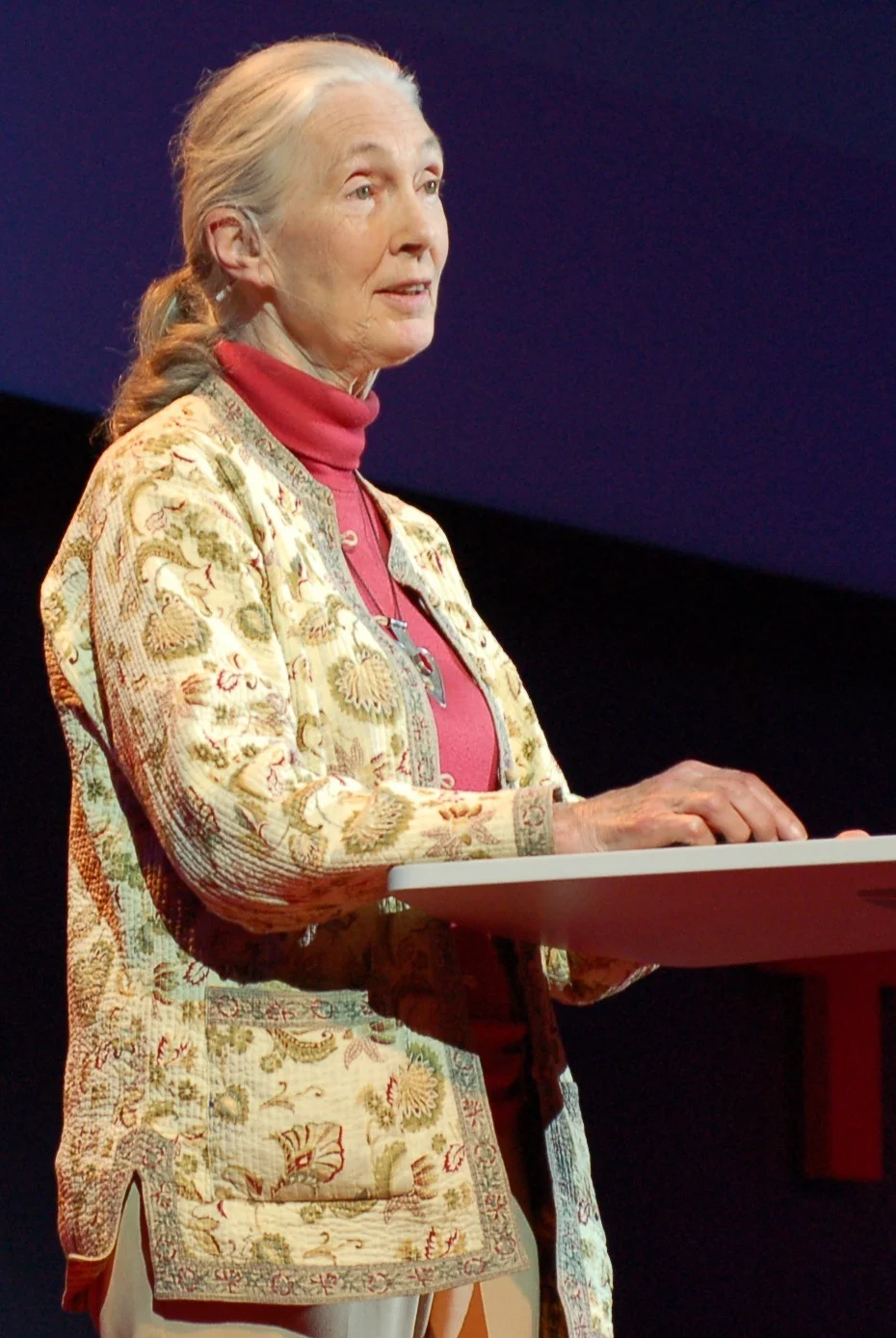
Jane Goodall
Wikipedia
Dame Valerie Jane Morris Goodall was an English primatologist and anthropologist. Regarded as a pioneer in primate ethology, and described by many publications as "the world's preeminent chimpanzee expert", she was best known for more than six decades of field research on the social and family life of wild chimpanzees in the Kasakela chimpanzee community at Gombe Stream National Park in Tanzania.
170 references
Question 3
Correct! Find more information:
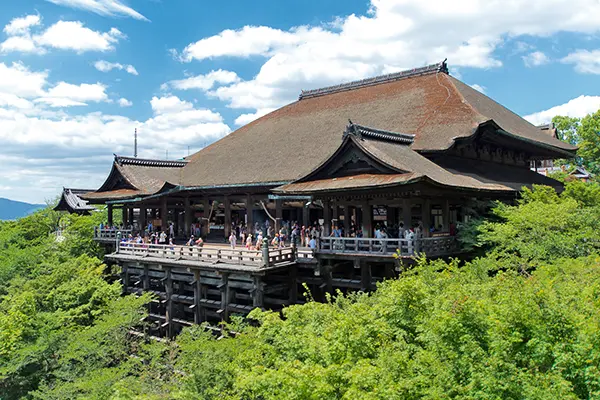
Kyoto
Wikipedia
Kyoto is the capital city of Kyoto Prefecture in the Kansai region of Japan's largest and most populous island of Honshu. As of 2020, the city had a population of 1.46 million, making it the ninth-most populous city in Japan. More than half (56.8%) of Kyoto Prefecture's population resides in the city.
60 references
Question 4
Correct! Find more information:
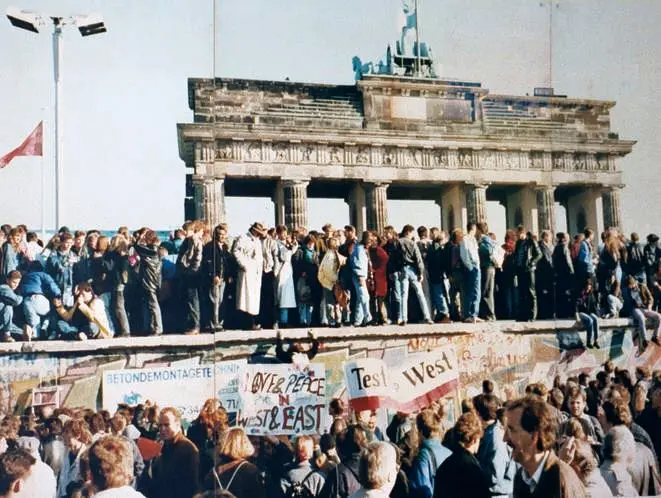
Fall of the Berlin Wall
Wikipedia
The Berlin Wall fell on 9 November 1989 during the Peaceful Revolution, marking the beginning of the destruction of the figurative Iron Curtain, as East Berlin transit restrictions were overwhelmed and discarded. Sections of the wall were breached, and planned deconstruction began the following June.
85 references
Question 5
Correct! Find more information:

Fennec fox
Wikipedia
The fennec fox (Vulpes zerda) is a small fox native to the deserts of North Africa, ranging from Western Sahara and Mauritania to the Sinai Peninsula. Its most distinctive feature is its unusually large ears, which serve to dissipate heat and listen for underground prey.
51 references
Question 6
Correct! Find more information:
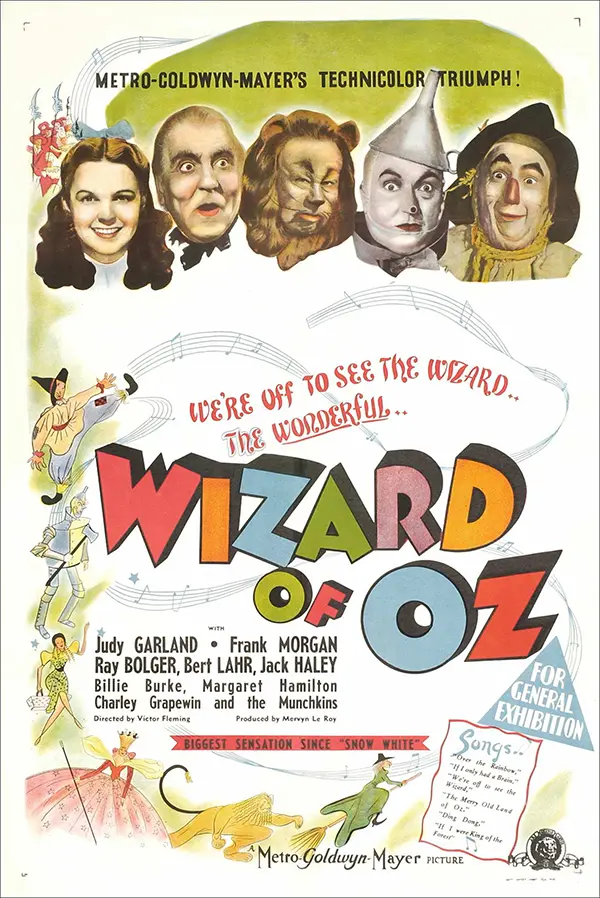
The Wizard of Oz (1939 film)
Wikipedia
The Wizard of Oz is a 1939 American musical fantasy film produced by Metro-Goldwyn-Mayer. Based on the 1900 novel The Wonderful Wizard of Oz by L. Frank Baum, it was primarily directed by Victor Fleming, who left production to take over the troubled Gone with the Wind.
224 references
Post-game
Essential attribution
Even in highly interactive settings, experiences need to acknowledge sources, albeit in a non-disruptive way. Providing clear essential attribution will ensure that the origin of the content powering the game isn’t lost in the flow of the experience. Essential attribution elements make Wikimedia projects’ role visible, maintain transparency, and enrich learners’ and players’ experiences by offering them the chance to verify information or explore further.
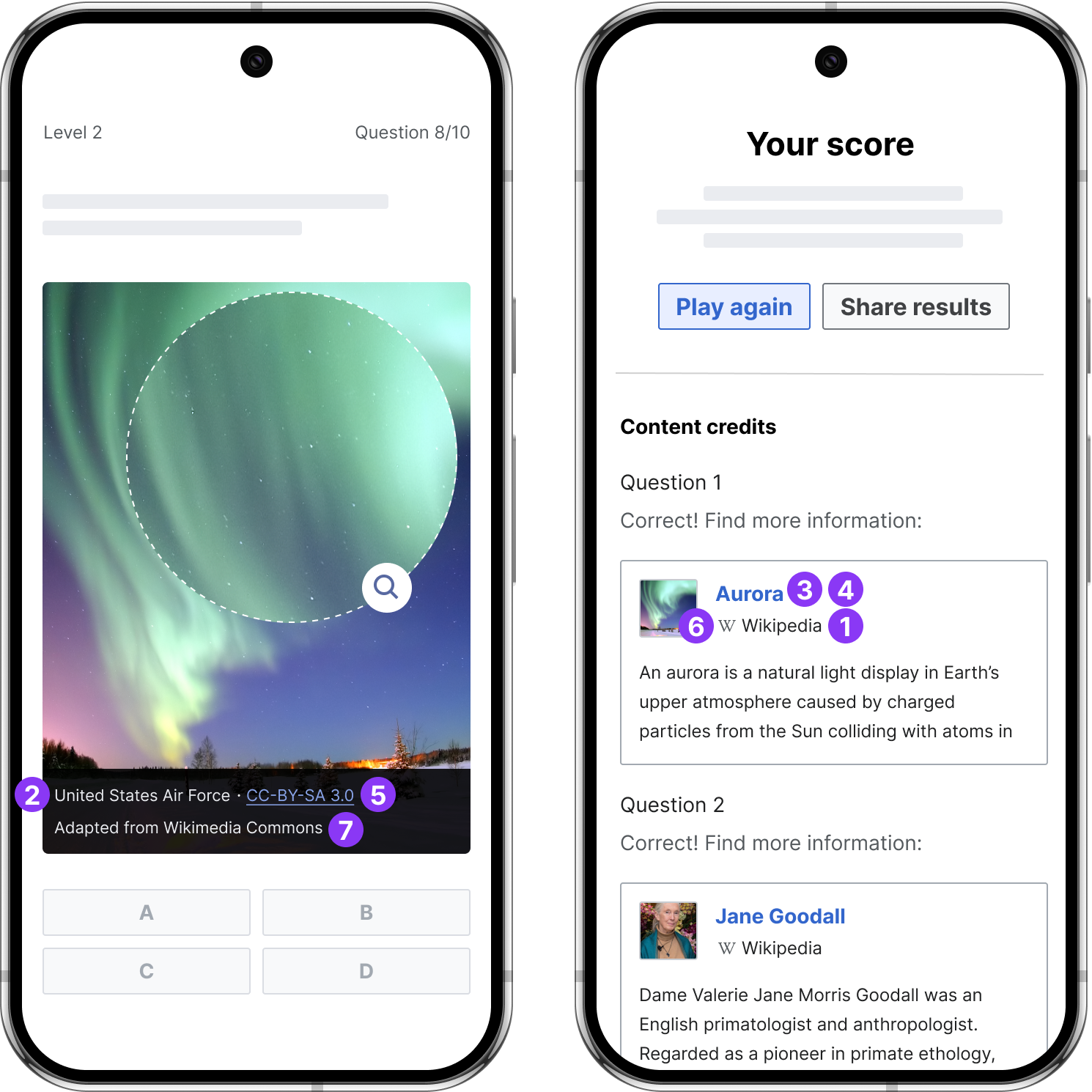
- Source • 2. Credit • 3. Link • 4. Title • 5. License • 6. Brand mark · 7. Modification disclaimer
Note: You may adjust the appearance of the signals to follow your design guidelines and visual style in order to ensure consistency in your context.
1. Source
Required
Reserve the appropriate space in the game flow to identify the Wikimedia project from which the information originates. Use text or, exceptionally, the project’s brand mark (see 6) to do so in case space is constrained. See full signal spec →
Data sources:
- Wikimedia Attribution API
BetaRecommended - Wikimedia Enterprise API
Recommended - MediaWiki Action API
- URL parsing
High visibility on wiki: This signal is immediately visible at the source.
2. Credit
Required based on license
Especially when media files are embedded, rich media and games should consider stating or provide direct access to the author’s information, as required by the file’s license. See full signal spec →
Data sources:
- Wikimedia Attribution API
BetaRecommended - MediaWiki Action API (Allows retrieving credit information about Wikimedia Commons media files)
Mixed visibility on wiki: The visibility of this information varies per project. For example, it's immediately visible in Wikimedia Commons' file pages but requires reviewing articles' history on Wikipedia.
3. Link
Required
Provide direct access to the specific Wikimedia project page where the content is being drawn from. This is essential to allow satisfying further information needs and providing access to verifiable licensing and authorship information. See full signal spec →
Data sources:
- Wikimedia Attribution API
BetaRecommended - Wikimedia Enterprise API
Recommended - MediaWiki Action API
- URL manipulation
High visibility on wiki: This information is immediately visible at the source.
4. Title
Required Exceptions may apply
Identify the name of the embedded media or the page where information originated. This signal can be omitted in favor of other core signals (e.g., source and link) in the face of space constraints.
Given that media files’ titles can be unwieldy and might not contribute a lot of meaning, we recommend omitting this information when attributing images. This suggestion applies only as long as access to the original file is provided in context. See full signal spec →
Data sources:
- Wikimedia Attribution API
BetaRecommended - Wikimedia Enterprise API
Recommended - MediaWiki REST API
- MediaWiki Action API
- URL parsing
High visibility on wiki: This information is immediately visible at the source.
5. License
Required based on license
Displaying the license type (and linking to more information about it) is required when media or content licenses carry usage restrictions. This information should be available in a secondary interface when space constraints or risk of cognitive overload apply. See full signal spec →
Data sources:
- Wikimedia Attribution API
BetaRecommended - Wikimedia Enterprise API allows fetching licenses as part of article's structured contents, or retrieving an article's license object.
Recommended - MediaWiki REST API
- MediaWiki Action API allows retrieving license information about projects and individual media files
High visibility on wiki: This information is immediately visible at the source.
6. Brand mark
Required if the source isn't stated
Use brand marks to visually identify the source of the information being reused. Project logos are convenient to ensure recognition when space is limited. See full signal spec →
Data sources:
Visual brand marks:
- Wikipedia Visual identity guidelines in Wikimedia Foundation's portal
- Other Wikimedia projects' brandmarks will be available in Wikimedia Commons
Coming soon - Wikimedia Attribution API
Beta - MediaWiki Action API
Audio brand marks:
High visibility on wiki: This information is immediately visible at the source.
7. Modification disclaimer
Required based on license
AI-generated outputs should be accompanied by clear disclaimers stating that When images or text from Wikimedia projects are presented in a derivative or altered form, applications are required to make modification disclaimers explicit.
If there is a risk for incorrect information to be attributed to Wikimedia in your application, we especially recommend including clear disclaimers. See full signal spec →
Trust and relevance signals
Recommended
Information reliability is important in all settings, but becomes particularly essential in educational experiences. Signals such as Reference count make visible the depth of sources behind the Wikipedia articles being reused in game experiences. The signal reinforces the notion that knowledge provided has been carefully curated by a human community. Integrating this cue into games and rich media experiences builds user trust while supporting the educational value of the experience.
Reference count
Use this Wikipedia-specific credibility signal to expose the number of sources backing an article’s content. See full signal spec →
Data sources:
- Wikimedia Attribution API
Beta - Wikimedia Enterprise API
- Crawling and self-parsing
Medium visibility on wiki: This information is verifiable when articles contain numbered reference lists.
Ecosystem growth signals
Recommended
Apps and games are uniquely positioned to spark curiosity and action. Including participation call to actions in secondary interfaces can help bridge the gap between learning from Wikimedia projects’ content and contributing to them. By creating integrated paths for players and learners to edit, improve, or join the Wikimedia community, reuse environments can inspire the next generation of contributors to sustain and expand free knowledge.
Participation CTA
Provide your users with options to contribute to the growth the free knowledge ecosystem. Clearly labelled contribution pathways can be embedded in a way that doesn’t disrupt immersive learning or gaming experiences. See full signal spec →
Data sources: